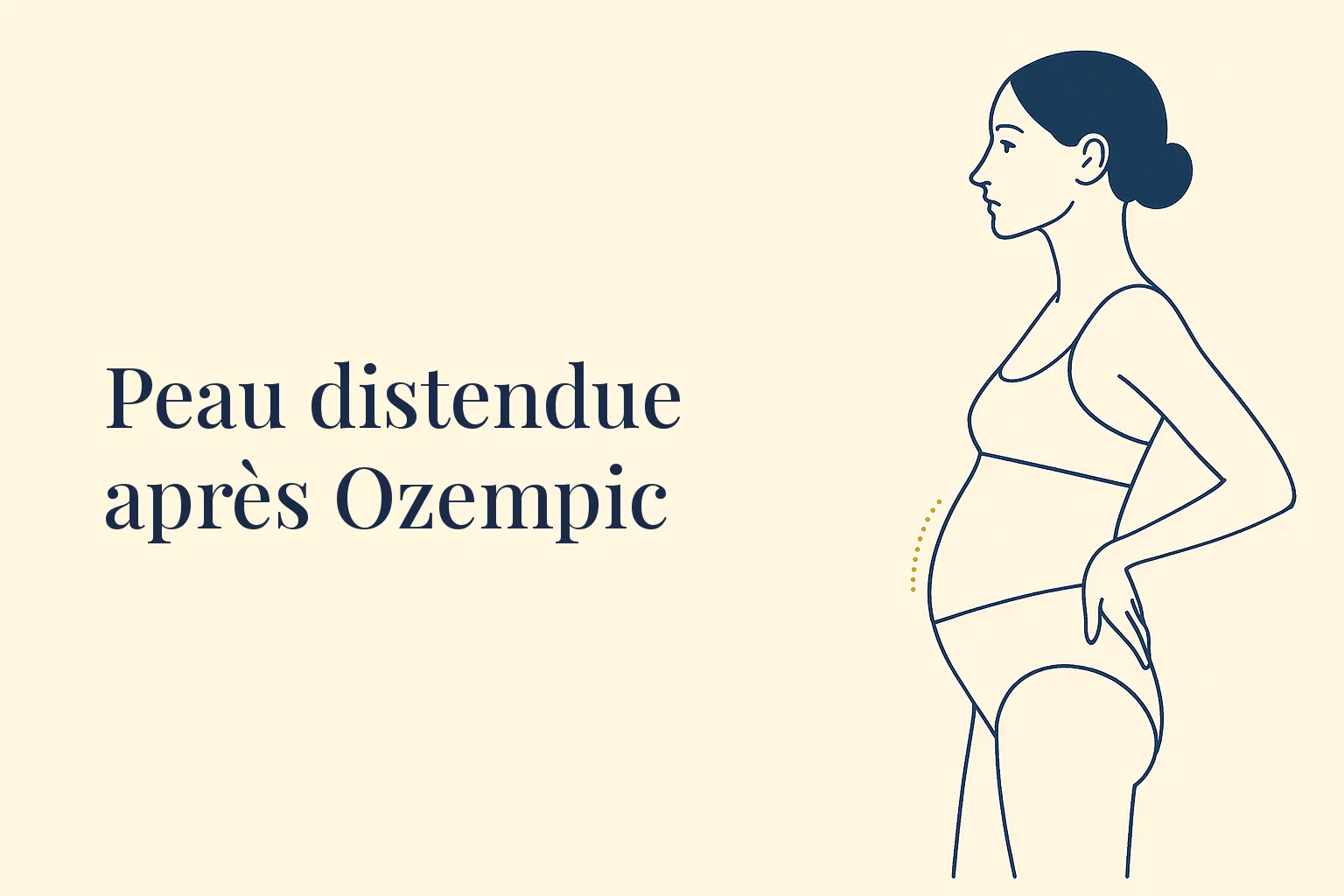
Skin laxity after Ozempic , Wegovy, or Mounjaro treatments has become one of the most frequent reasons for consultation in body contouring surgery. The reason is mechanical: these treatments cause rapid and significant weight loss, and the skin does not retract at the same rate. The result is sometimes confusing for patients, who reach their target weight but discover a figure they hadn't anticipated. This article explains why this discrepancy occurs, when it becomes relevant to intervene, and what solutions exist depending on the areas affected.
An important clarification before we delve into the subject: these medications require a prescription from a general practitioner, endocrinologist, or nutritionist within a defined medical framework. They are neither prescribed nor dispensed in the doctor's office, and this article is not intended as an endorsement of their use. It is aimed at individuals who are already undergoing such treatment, or who have completed it, and are wondering what to do next.
From injection to tablet: the ongoing evolution
GLP-1 analogs mimic the action of an intestinal hormone that slows gastric emptying and acts on the satiety centers. Semaglutide, marketed as Ozempic for type 2 diabetes and Wegovy for obesity, paved the way. Tirzepatide, marketed as Mounjaro, amplified this effect by acting on a dual hormonal target, both GLP-1 and GIP. Liraglutide, an older drug, is known as Saxenda.
The ongoing transformation concerns the route of administration. Following oral semaglutide, already available under the name Rybelsus, a new generation of oral molecules is in advanced development, including orforglipron, which requires neither injection nor special storage conditions. If these products confirm their effectiveness and obtain approval, the shift from injection to tablet will significantly expand the number of people who can benefit from this treatment.
This development is of direct interest to plastic surgery, for a simple reason: the more accessible the treatment becomes, the greater the number of patients facing excess skin after weight loss. It is no longer a marginal phenomenon.
Why doesn't the skin keep up?
The skin possesses a natural retraction capacity, ensured by its network of collagen and elastin. This capacity has limits, and four factors determine whether it will be exceeded.
The first factor is the rate of weight loss. This is the most specific factor for GLP-1 treatments: weight loss spread over two years allows tissues time to adapt, whereas equivalent weight loss in six months does not. The second factor is the extent of the loss : beyond a certain number of kilograms, excess skin becomes mechanically unavoidable, regardless of skin quality. The third factor is age , as the elasticity of the dermis decreases with age. The fourth factor includes medical history : pregnancies, repeated weight fluctuations, smoking, and chronic sun exposure.
An often underestimated factor is muscle loss. Rapid weight loss doesn't just melt away fat; muscle loss accentuates the appearance of sagging by eliminating underlying support. This is why sufficient protein intake and maintaining resistance training during treatment truly alter the final appearance of the figure. The same mechanism explains, in the face, the phenomenon now known as " Ozempic face ," which can be largely prevented even before the first injection.
When should you consult?
The rule is constant: surgery should not be performed on a weight that is still shifting. An operation carried out while weight loss is ongoing risks a worse outcome, as new excess weight will appear. Therefore, a stable weight over a sufficient period, generally several months, is necessary, as well as a verified nutritional balance, since the state of protein and vitamin reserves directly affects healing.
However, there's nothing wrong with consulting during treatment to anticipate skin laxity after Ozempic or any other GLP-1 analog. In fact, this is often the best time: it allows for an assessment of skin quality before it's subjected to stress, adjustments to habits that influence the outcome, and knowing what to expect rather than discovering it unexpectedly. A pre-treatment consultation does not obligate you to undergo any procedure.
Loose skin after Ozempic: solutions depending on the area
There is no single treatment for post-weight loss sagging: the response depends on the area and especially on the degree of excess skin.
When the skin retains good elasticity and the excess fat remains moderate, minimally invasive techniques are often sufficient. Radiofrequency acts on skin retraction by stimulating collagen, without scarring, and can be combined with liposuction when localized fat deposits persist that are resistant to weight loss—a common occurrence, as weight loss is never distributed evenly.
When there is significant excess skin, no technology can replace surgical removal. In the abdomen, the most commonly affected area, an abdominoplasty removes the excess skin and tightens the abdominal wall, sometimes including tightening the rectus abdominis muscles. For the arms, brachioplasty addresses sagging of the inner thighs. For the thighs, a thigh lift follows the same principle. When the sagging is circumferential and affects the entire waistline, a body lift addresses the abdomen, flanks, and lower back in a single procedure.
These procedures leave scars, the location and length of which are explained and drawn during the consultation. This is the central trade-off of this surgery: accepting a scar in exchange for the removal of excess skin. There is no solution that avoids both. All the techniques are presented in the "Silhouette" section , and the practical details are in the "Pricing" section.
A multi-stage planning is common when several areas are involved, in order to limit the operating time and facilitate recovery.
F.A.Q
Can skin retract on its own over time?
Partly, yes: retraction continues for several months after weight stabilization, justifying waiting before surgery. Beyond a certain degree of excess weight, however, this spontaneous retraction remains insufficient.
Should treatment be stopped before an intervention?
The question arises and is resolved in consultation with the prescribing physician and the anesthesiologist, particularly because these medications slow gastric emptying, which has implications for preoperative fasting instructions. It is never a decision made alone.
How long should you wait after the weight loss is complete?
There is no universal timeframe: the criterion is weight stability over several months, combined with satisfactory nutritional status. These elements are verified during the pre-operative consultation.
Can radiofrequency abdominoplasty replace a full abdominoplasty?
No, the two do not treat the same situation. Radiofrequency improves moderate skin laxity on skin that is still elastic. For established excess skin, only surgical removal provides correction.
What should be done if the face has become hollow?
Hollowing out the face requires a distinct approach, both preventive and corrective, detailed in our article on the Ozempic face.
This article is for informational purposes only and does not replace a medical consultation.