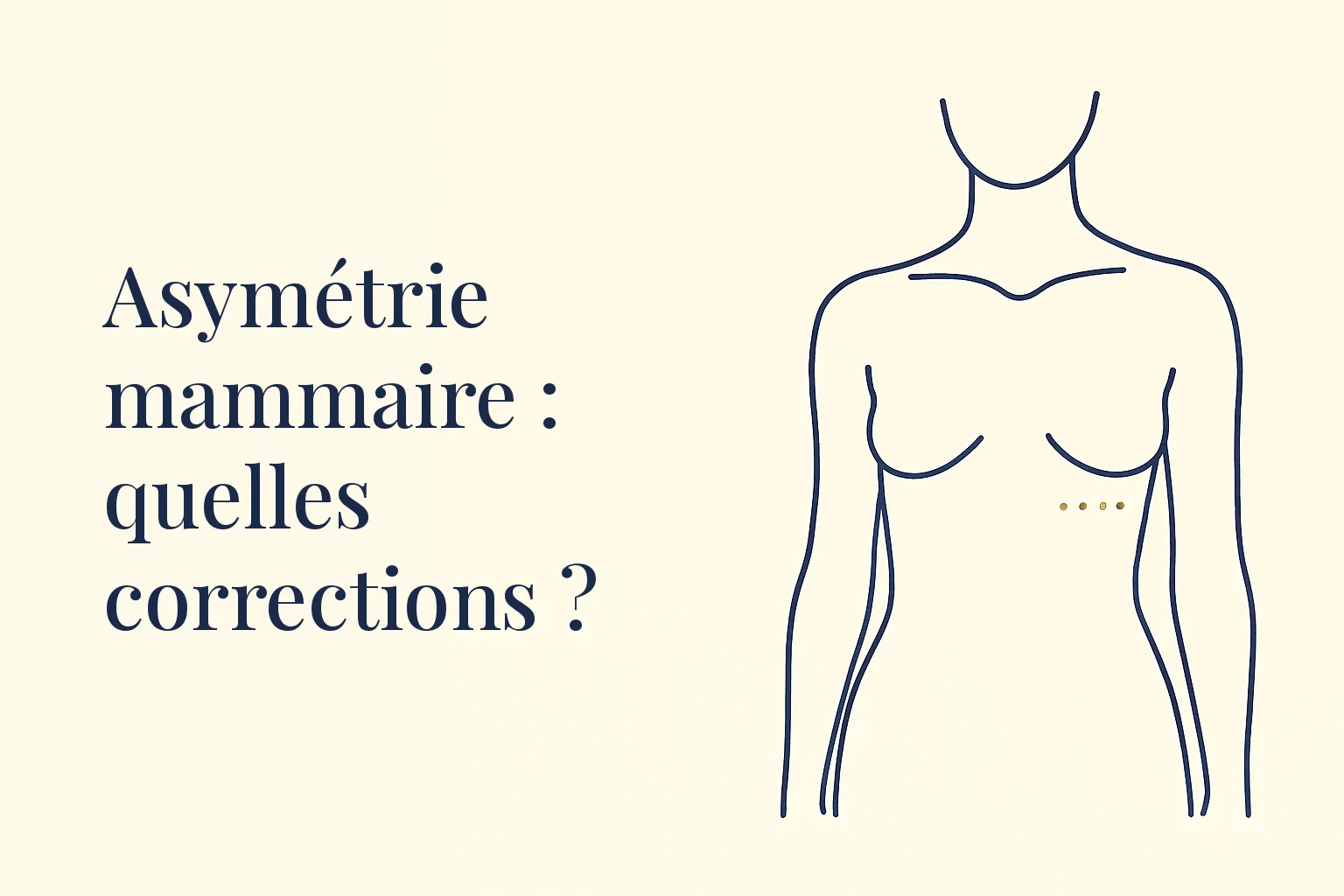
A slight breast asymmetry exists in the vast majority of women: the two breasts are never perfectly identical, any more than the two halves of a face. The issue only arises when the difference becomes noticeable when dressed, hindering clothing choices or impacting self-confidence. In this case, several solutions exist, and the choice depends less on the surgeon's preference than on the precise nature of the asymmetry: does it involve volume, shape, or position? This article details each situation and the corresponding techniques.
Breast asymmetry: three shapes, three correction strategies
First of all, you need to name precisely what you want to correct, because the actions are not the same.
Asymmetry in volume is the most common: one breast is larger than the other. It can be present from puberty or appear after pregnancy, breastfeeding, or significant weight fluctuations. Two strategies are then possible: augmenting the smaller breast or reducing the larger one. The choice depends on the overall volume desired by the patient and is rarely neutral: a woman satisfied with her smaller breast will opt for a breast reduction on the opposite side, while a woman who finds both breasts underdeveloped will prefer asymmetrical augmentation.
Asymmetry of shape refers to the curve, projection, or spacing of the breasts. It includes so-called tuberous breasts, where the base of the breast is too narrow and the areola is distended, often unevenly between the two sides. Correcting it is more technical, as it is not enough to simply add or remove volume: the base must be reshaped and the tissues redistributed.
Finally, positional asymmetry refers to a difference in the height of the inframammary fold or the level of the areola, with one breast drooping more than the other. It is addressed through a breast lift , possibly unilateral, and not through volume augmentation.
In practice, these three components often combine, and the consultation serves precisely to disentangle them. Measurements taken in a standing position — areola height, base width, sternum-nipple distance, sulcus position — objectify what the eye perceives only vaguely.
Correcting with lipofilling: the solution for moderate asymmetries
When the difference remains moderate, breast lipofilling is often the most elegant solution. It involves harvesting fat via micro-liposuction and then reinjecting it in micro-droplets into the less developed breast, allowing for very gradual volume adjustments and targeting of specific areas, such as the upper pole.
Its advantages are real: no implants, a natural feel, scars reduced to entry points, and a secondary benefit to the donor area. Its limitations are equally significant: sufficient fat reserves are required, some of the graft is reabsorbed in the following months, and the volume gain per session remains limited. Therefore, significant asymmetry cannot be corrected in a single procedure using this method.
Correcting with prostheses: the contribution of the minimally invasive approach
Beyond a certain point of difference, or when the patient also wishes to increase overall volume, implants once again become the most reliable solution. Their strength, particularly in the case of breast asymmetry , lies in the precision of the calibration: it is possible to choose two implants of different volumes, profiles, or base widths, one on each side, to restore balance rather than simply replicating the difference on a larger scale. This is a point that patients often overlook: asymmetrical augmentation is not only possible, but it is precisely the appropriate approach in this situation.
The question of the scar remains, often a deciding factor for patients who are seeking to correct an insecurity and have no desire to create a new one. This is where the MIA ( Minimally Invasive Augmentation ) approach comes in, developed to reduce the length of the incision and conceal the scar. Dr. Nathaniel Stroumza-Escoffier was the first French surgeon trained in this technique, which he practices in the 8th arrondissement of Paris.
Its advantage in cases of asymmetry is twofold. Firstly, discreet scarring is particularly important when operating on only one breast, or on both breasts unevenly: a scar visible on only one side would draw attention precisely where it was intended to be avoided. Secondly, the technique is frequently performed under deep local anesthesia, which simplifies the recovery. Like any surgical procedure, it has indications and contraindications that are assessed during a consultation, and it is not suitable for all body types. The comparison between MIA implants and lipofilling details the selection criteria for each approach.
Special cases: tuberous breasts and unilateral hypoplasia
Some asymmetries go beyond a simple difference in volume. Tuberous breasts combine a narrow base, insufficient height, and herniation of glandular tissue into the areola; their correction generally involves reshaping the base, treating the areola, and adding volume. Marked unilateral hypoplasia, where one breast has barely developed, may require a multi-stage approach.
These situations cannot be treated with a single protocol. They require detailed, sometimes phased, planning and clear communication that absolute symmetry is not a realistic goal: the objective is a difference that is no longer noticeable when clothed and that becomes acceptable to the patient. You will find all the available techniques in the breast surgery section.
The consultation process
The initial consultation includes a complete clinical examination with standardized measurements and photographs, an analysis of the expressed need—what the actual problem is and under what circumstances—and a presentation of the options with their respective limitations. Imaging tests are requested depending on the patient's age and medical history. A period of reflection is observed before any decision is made, and the practical details are outlined in the fees section.
F.A.Q
Is breast asymmetry abnormal?
No, a slight difference is the rule rather than the exception. It only warrants medical attention when it is visible and perceived as bothersome. However, a recently developed asymmetry, or one associated with a change in the skin or nipple, should be evaluated by a doctor without delay.
Is it possible to operate on only one breast?
Yes, it's quite common. However, it's important to anticipate that the two breasts will change differently over time, especially in the case of pregnancy or weight fluctuations, and that the result may require further adjustment.
Can two prostheses of different volumes be used?
This is precisely the logic behind asymmetry correction. The volume, profile, and base width are chosen independently for each side, based on measurements taken during the consultation.
Is lipofilling sufficient to correct a significant asymmetry?
Rarely in a single session. The volume gain per session is limited, and some of the fat is reabsorbed. For a significant difference, several sessions are necessary, or a combined approach is considered.
Should we wait until we have had children?
Pregnancy and breastfeeding alter the size and position of the breasts, even after correction. The question therefore arises and is discussed during a consultation, taking into account lifestyle plans and current level of discomfort.

This article is for informational purposes only and does not replace a medical consultation.